Interview with Claire K. McKeever-Burgett
By: Anna Grace Glaize
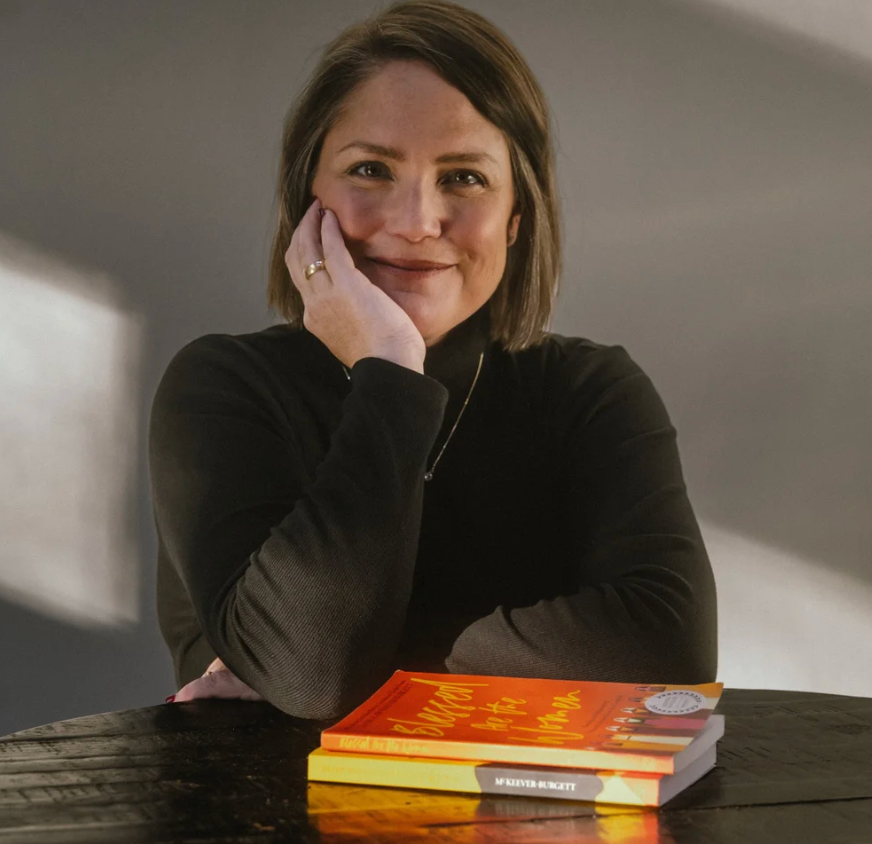
Photo courtesy of https://www.clairemckeeverburgett.com
Claire K. McKeever-Burgett is a feminist theologian and writer. On August 13, 2026, she was generous enough to speak with us about her journey to becoming an author, how childbirth shaped her understanding of God, and which woman in the Bible is ready for the big screen. This interview has been edited for clarity and length.
AGG: Claire, you have now written two books about women in Scripture: Blessed Are the Women and In the Beginning Were the Women. Can you tell me a little bit about how those books came about?
Claire McKeever-Burgett: Blessed Are the Women is the result of many, many years of dreaming and planning and thinking, but I originally had the idea in 2018, when I was invited to preach in the Upper Room Chapel [in Nashville, Tennessee] during Lent and Women's History Month. I read the lectionary Scripture passage for that week, and it was the woman who anoints Jesus' feet with oil. I immediately asked, “What is your name?” Then, I wrote the sermon as if I were her, and her name was Eve. When I preached it, it was beautifully, graciously received.
I thought, “If I can do this, with this woman…” So I jotted down an outline, and from there, I just needed to live more life. We were in the midst of trying to get pregnant with our second child, and then I gave birth to her, and then, six months later, COVID hit. All to say, Blessed Are the Women started in 2018 and didn’t get published until 2024.
In the Beginning Were the Women is like the big sister to Blessed Are the Women. In Blessed, I write about ten women in the Synoptic Gospels, and in In the Beginning, I write about sixteen women from the Hebrew Bible, which came out last fall.
AGG: The books are primarily written in the voices of the biblical women. What kind of work did you do to get into the right headspace for that kind of writing?
Claire McKeever-Burgett: I wrote every Monday, and in the days leading up to writing, I would read Scripture—a lectio divinia kind of reading—so that there was almost an awareness living in me before I sat down to write. That way, when I did write, it wasn’t my first time meeting these women.
Then, when I write, I have to make sure I’m alone, because writing, for me, is an embodied practice. The times I struggle most with writing are when I’m just thinking about it. I need to be in a place where I can feel about it, emotionally, but also physically. That is very sacred to me, so I have to be at home or in a quiet place.
AGG: It makes sense that you are so focused on embodiment in both the book and in your writing practice, because, besides having an M.Div from Vanderbilt, you’re a certified doula, a yoga instructor, a dance instructor, and a martial arts instructor.
Claire McKeever-Burgett [laughing]: Yeah, so a little explaining. I’m trained in the practice of Nia, which combines yoga, martial arts, and dance. I’m also a prenatal yoga certified teacher. I want to be real clear: I don't practice any of those things at the moment. Those were very present in my 20s and 30s, but I have not taught a regular class since the pandemic. Now, though, when I lead retreats, being able to move and breathe along with the text we're reading is a really important practice.
AGG: So I can't hire you to teach me kickboxing, is what you're saying.
Claire McKeever-Burgett: Probably not.
AGG: What did being a doula teach you about God?
Claire McKeever-Burgett: I don't know that I've ever been closer to God than when I personally have given birth. And being able to witness a parent bring a child into the world is, in many ways, beyond words for me: it’s sounds, it’s moans, it’s hums, it’s movement.
What I learned is, in many ways, God is the doula. God is called the deliverer so many times in the Hebrew Bible and the New Testament. “Deliverer,” like a mother delivers a baby. God is the midwife, bringing us where we need to be, and who is with us in the groaning, with us in the pain, with us in the struggle.
I also think it’s important for me to note that, as a doula, I learned about the divinity of women. Do I think we are the Divine Almighty? No. We are human beings. But we are human beings who are so deeply sacred. Not just mothers—women, in general. I mean, we bleed and do not die, and that has been used against us for centuries instead of honored. I write about this in Blessed, but after giving birth to my first child, I was like, “The fact that we’re not carried around on pillows is really something…”
AGG: A lot of your retellings are more action-packed than some might expect. What woman in the Bible is ready for the Hollywood treatment?
Claire McKeever-Burgett: Deborah would be cool, because she’s this warrior but also this prophet and mystic. But the wise woman from Abel Beth-Maacah would be freakin’ incredible. I mean, she hurls a man’s head over a wall to save her people! Plus, in my research, I learned that wise women were normal before the monarchy came along. Going to the wise woman was a normal, everyday practice.
[In the 2 Samuel story, when Abel Beth-Maacah is under siege by Joab, the wise woman parleys with the military commander. They come to an agreement: the city will give him Sheba, the leader of the revolt against David. The terms of the agreement are reached when the wise woman throws Sheba’s head over the city’s walls.]
AGG: Who is your favorite woman in the Bible today? And why is she speaking to you right now?
Claire McKeever-Burgett: Mother Mary is my ride or die. She is on many altars in my home. I believe in little altars everywhere, reminding us that the sacred is always among us, even when we're telling dogs to stop jumping and kids to put up their dirty plates.
I think about Mary often as a parent, not only to Jesus but to his brothers and sisters. Parenting has been and is the most intense spiritual formation that I have gone through, and I mean that sincerely. The prayers we pray together and the stories we read together remind me that the formation is mine, but their relationship with the divine is theirs, right? I get to be a part of that relationship, and alongside that relationship, but I’m not in control of it. I remember that daily, and I like to think Mary shows us that in the way she lived. I resonate with her today, because I have to believe she carried so much—grief and joy and pride and wonder.
AGG: Finally, what's next, Claire?
Claire: I’m working on my third book. It’ll come out in the fall of 2027 with Westminster John Knox Press. It is 40 psalms of wisdom, justice, sorrow, and delight. Each psalm has background to situate it in context, and they’re imagined as if they’re sung by women.
It’s been a gift to write, and a pretty intense season, because it’s due September 1. Any prayers you want to send my way are appreciated.
AGG: I’ll light a candle for you, Claire!
Claire: Thank you! Then I get to go lead a women’s retreat in Portland, Oregon, in September. I just give real thanks for a life that allows me to celebrate the women.