Girl Dads of the Bible
By: Anna Grace Glaize
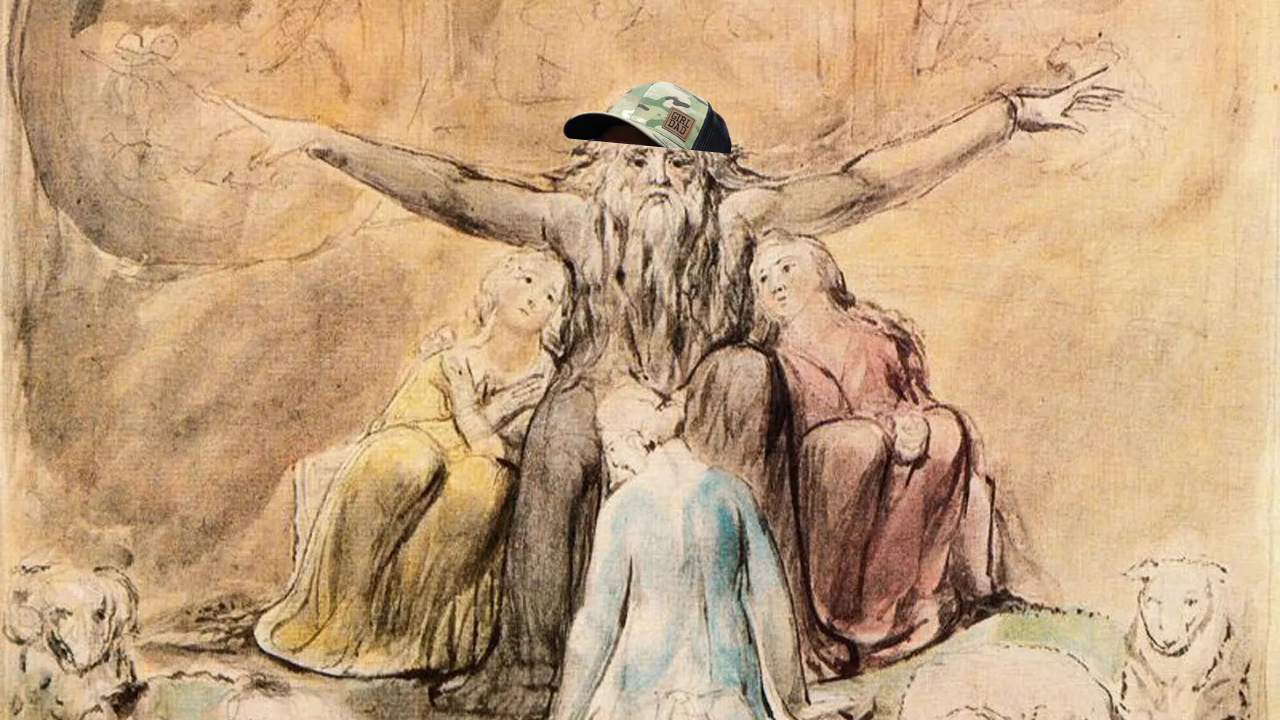
William Blake’s “Job and His Daughters” (photo from Wikimedia Commons) wearing Bradley Cooper’s Girl Dad hat. (1)
In honor of Father’s Day this month, we wanted to highlight some fathers of daughters in Scripture. Before sharing the highlights, though, the lowlights must be acknowledged, because there are some epicly bad dads of the Bible: Lot, you seemed pretty quick to throw your daughters to the violent mob. Jephthah, child sacrifice is just never the move!
Disappointing dads aside, there are some lovely father-daughter moments in the Bible, too. Girl dads, past and present, here’s to you!
LABAN
Laban, the trickster father of Leach and Rachel, is not the ideal father-in-law to their husband Jacob. But as fathers go, Leah and Rachel could do worse. After years of tension between Jacob and Laban, Jacob decides it’s time to return to his father’s home in Canaan. Knowing his father-in-law will try to stop him, he and his household leave without informing Laban. When Laban hears the news, he catches up with the travelers and, in Genesis 31:43-55, expresses real concern for his daughters and his many grandchildren.
In Genesis 31, Laban says to Jacob, “The daughters are my daughters, the children are my children, the flocks are my flocks, and all that you see is mine. But what can I do today about these daughters of mine or about their children whom they have borne?... The Lord watch between you and me, when we are absent one from the other. If you ill-treat my daughters or if you take wives in addition to my daughters, though no one else is with us, remember that God is witness between you and me.”
Jacob and Laban make their peace and break bread together. Early the next morning, “Laban rose up and kissed his grandchildren and his daughters and blessed them; then he departed and returned home” (Genesis 31:55). While Laban may be the antagonist in many of the Jacob stories, by the time he exits the narrative, he’s no longer the villain. Instead, he’s a concerned father who won’t let his girls go until he’s certain they’ll be safe.
CALEB
Caleb, the Israelite spy who accompanied Joshua into the promised land on an espionage mission, had a daughter named Achsah. During the conquest of the land, she is married to Othniel after he successfully captured Kiriath-sepher (Joshua 15:16-19). As a wedding present, she tells Othniel to ask her father for land. But when she greets her father, she tells him to give her not just land but springs of water as well, a savvy decision in an arid environment.
Notice that while Achsah is first presented as a prize to be won, she quickly asserts herself in the story. She’s the one telling her new husband, the war hero, what to do once they’re married. And in her conversation with her father, she shows no hesitancy in her desire for vital resources. It’s fitting that the daughter of the man brave enough to sneak into enemy territory is bold enough to say exactly what she wants. And to Caleb’s credit, he does as she says, going against the patrilineal custom of ancient Israel to do so.
JOB
Job is famously plagued by disaster at the beginning of his story, including the loss of his three daughters and seven sons. At the end of the story, though, Job finds himself restored, and he has three more daughters and seven more sons. Curiously, only the second set of daughters are named in the story, and it’s Job who names them. His name-giving is unique; this is the only place in the Bible where a father names his daughters.
Additionally, Job gives his daughters an inheritance, though according to biblical law, women could inherit only in the absence of a male heir. Yet Job, called by God, “a blameless and upright man,” goes against convention and gives his daughters an inheritance along with his sons (Job 1:8).
JAIRUS
Jairus was a synagogue leader whose twelve-year-old daughter became gravely ill. Desperate to save her, Jairus seeks out Jesus and tells him, “My little daughter is at the point of death. Come and lay your hands on her, so that she may be made well and live” (Mark 5:23). Jesus goes with Jairus, but their progress is slowed by the large crowd surrounding Jesus. Their journey is further delayed by a woman whose life has been disrupted by a twelve-year flow of blood.
Before they even arrive at Jairus’ home, they’re told it’s too late. Jairus’ daughter is already dead. Jesus comforts Jairus, telling him, “Do not be afraid; only believe” (Mark 5:36). They continue to the house, and Jesus goes to the girl, takes her hand, and says, “Little girl, get up!” (Mark 5:41). The girl is raised, and her parents are “astounded”; those present are “overcome with amazement” (Luke 8:56; Mark 5:42).
Jairus believed his daughter would be returned to him despite all signs to the contrary. How lucky for her to have a father like that. And how lucky are we to have sacred stories where little girls and bleeding women are met with miracles by a savior found not in a palace, but among the crowd.
PHILIP
Philip was one of seven leaders elected to serve the Jerusalem church (Acts 6:1-6). After the stoning of Stephen, Philip left Jerusalem for Samaria. During his ministry, he memorably baptized the Ethiopian eunuch. Philip apparently passed on his gifts for ministry to his children. His four daughters, all unmarried, were famed for their prophetic abilities (Acts 21:8-9).
That the four women are identified as prophets is significant. “Prophets played an important role in the early church. Being gifted by the Holy Spirit, they provided guidance, instruction, strengthening, encouragement, and comfort (Acts 13:3–4; 16:6; 1 Cor. 14:3, 31, etc). Paul considered prophecy to be the most desirable of the spiritual gifts (1 Cor. 14:1), and he listed prophets and prophesying before teachers and teaching in his lists of ministry gifts in Romans 12:6–8, 1 Corinthians 12:28, and Ephesians 4:11” (“Philip’s Prophesying Daughters” by Marg Mowczko).
Though mentioned only briefly in Acts, the four daughters are spoken of positively by the early church historian Eusebius. In his Ecclesiastical History, Eusebius claims the four daughters were vital in providing the Bishop of Hierapolis, Papias, with oral accounts of Jesus and his first followers (E.H. 3.39.9). Eusebius also affirms their role as trustworthy prophets, highly regarded for their leadership (E.H. 5.17.3). Happy Father’s Day to Philip, a celebrated leader in his own right, and a man who raised women of renown.
RESOURCES:
(1): William Blake’s “Job and His Daughters” (photo from Wikimedia Commons) wearing Bradley Cooper’s Girl Dad hat.