Tamar (Daughter of David)
2 Samuel 13:10-14 So Tamar took the cakes she had made and brought them into the chamber to Amnon her brother. But when she brought them near him to eat, he took hold of her and said to her, “Come, lie with me, my sister.” She answered him, “No, my brother, do not force me, for such a thing is not done in Israel; do not do anything so vile! As for me, where could I carry my shame? And as for you, you would be as one of the scoundrels in Israel. Now therefore, I beg you, speak to the king, for he will not withhold me from you.” But he would not listen to her, and being stronger than she, he forced her and lay with her.
2 Samuel 13:30-32 …the report came to David that Absalom had killed all the king’s sons, and not one of them was left. The king rose, tore his garments, and lay on the ground, and all his servants who were standing by tore their garments. But Jonadab, the son of David’s brother Shimeah, said, “Let not my lord suppose that they have killed all the young men the king’s sons; Amnon alone is dead. This has been determined by Absalom from the day Amnon raped his sister Tamar.
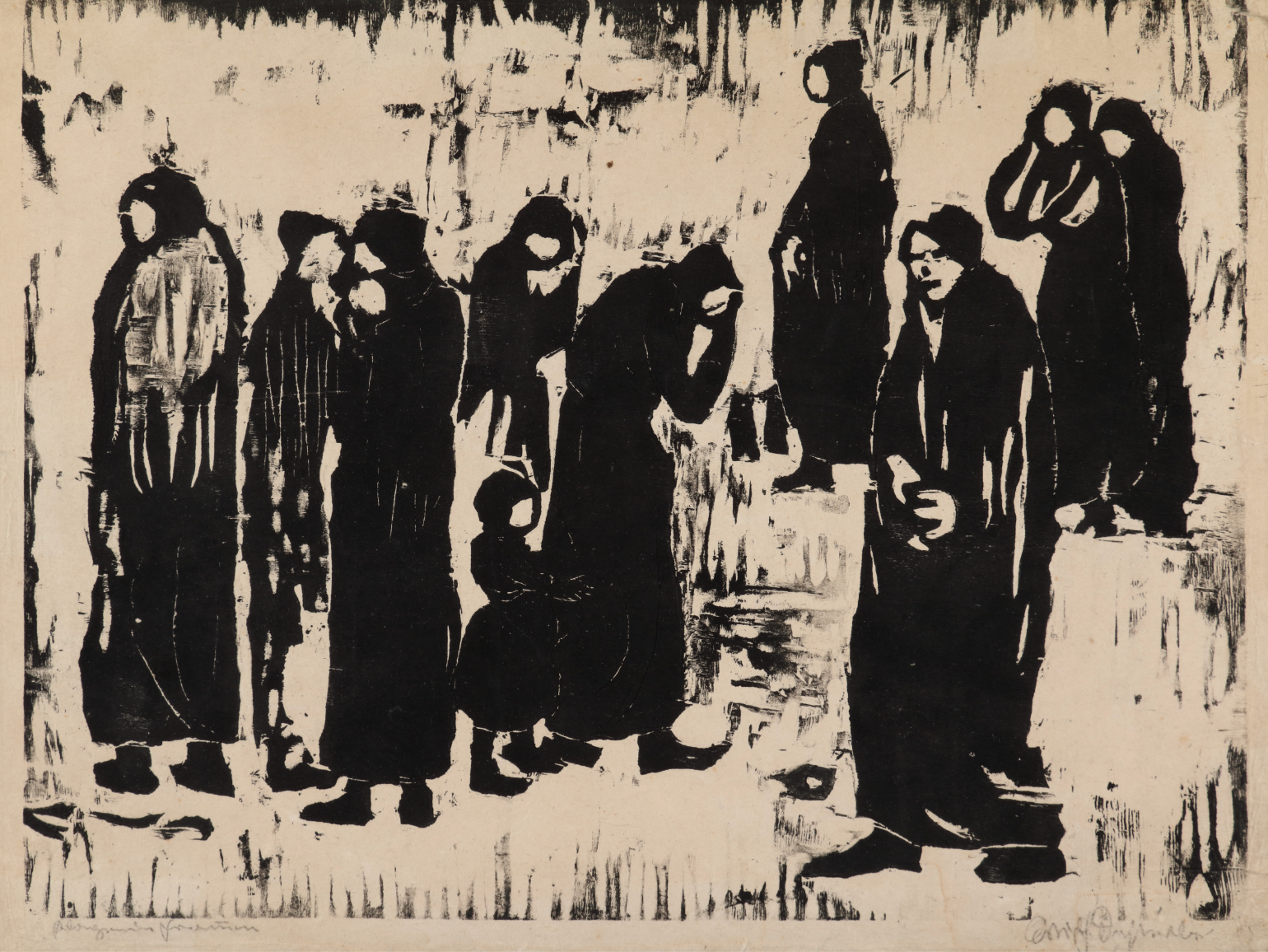
Artwork: Mourning women woodcut from the High Art Museum.
Sometimes our Scriptures inspire, sometimes they comfort, and sometimes they disturb.
This is Tamar’s story, or at least what we know of it: Tamar is introduced in 2 Samuel 13 as beautiful and young. She must’ve been kind, too, because when she hears that her half-brother Amnon is sick, she goes to make him food. Young, beautiful, and the daughter of Israel’s king, Tamar should have been safe. She wasn’t.
Amnon was not sick.
No, he faked his illness to get his half-sister alone; he was aided by his cousin, Jonadab. The men in her own family conspired to do her harm, and harm was done. Tamar was raped by Amnon.
Afterward, Tamar expresses her grief through public mourning; her brother Absalom tells her to keep quiet. King David, when he hears what has happened, does nothing to grant his daughter justice.
In an act of vengeance, Absalom kills Amnon. He flees Jerusalem and lives in exile for three years before reuniting with King David. Their reconciliation does not last. Absalom himself dies after leading a rebellion against his father.
There is a dark and troubling irony in this story. After all, the Book of Samuel is filled with battles, but the greatest threat to Tamar is not the mighty Philistines or the enemy Amalekites. No, it’s the men within her own house. Tamar has one brother who will not hear her “no,” and another who is willing to commit murder in her name and yet silences her grief. Tamar has a father who can slay a giant, but who will not give his own daughter justice.
Tamar’s story is tragically defined by the men in her life. But even so, the text grants her glimmers of agency. Her act of mourning bears a striking resemblance to public protest. Tamar is not silenced. Thousands of years later, her lament is sealed in Scripture.
Tamar’s story is what scholar Phyllis Trible calls a “text of terror,” and there is terror in her story. But, as with all sacred writing, there is truth, too.
There are three Tamars in the Bible. The first is found in Genesis 38; she is an ancestor to David, and thus, to his daughter. The second is this Tamar, the Tamar of 2 Samuel 13. The third is Absalom’s daughter, named in honor of his sister.
Tamar’s story is too much with us: according to the CDC, as of 2026, nearly half of women and more than 1 in 6 men have experienced contact sexual violence in their lifetimes.
“In the aftermath of her assault, Tamar continues to use her voice, her agency, what is left of her power. She does not hide her assault or own its shame as her own. In 2 Samuel 13:19, Tamar proclaims publicly so that it may be Amnon’s shame…She cries, not silent tears but a cry (z-‘-q) loud as the cries heard in battle, the cries of women in labor, and the cries of a desperate people to their God (e.g., Exod.2:23; 1 Sam.1420; Isa. 26:17).” (Womanist Midrash by Wilda C. Gafney, p. 230).

List of Reading & Resources:
Articles
“Read the Rape of Tamar, and Pay Attention to the Verbs” by Anna Carter Florence
"Her Name Was Tamar – Invasive, Destructive, Redemptive" by Prof.Jacqueline Vayntrub
Books