Tamar (Daughter-in-Law of Judah)
Genesis 38; Ruth 4:12; 1 Chronicles 2:4; Matthew 1:2-3
Genesis 38:6 Judah took a wife for Er his firstborn; her name was Tamar.
Ruth 4:12 …and, through the children that the Lord will give you by this young woman, may your house be like the house of Perez, whom Tamar bore to Judah.
1 Chronicles 2:4 His daughter-in-law Tamar also bore him Perez and Zerah. Judah had five sons in all.
Matthew 1:2-3 Abraham was the father of Isaac, and Isaac the father of Jacob, and Jacob the father of Judah and his brothers, and Judah the father of Perez and Zerah by Tamar, and Perez the father of Hezron, and Hezron the father of Aram.
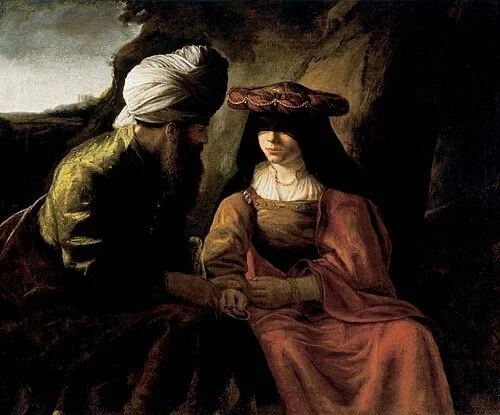
Judah and Tamar, school of Rembrandt, circa 1650. Photo from Wikimedia Commons.
Tamar, ancestress of David and Jesus, is mistaken for a prostitute by her father-in-law and tricks him into having sex with her. And at the end of the story, her father-in-law says, “She is more in the right than I” (Genesis 38:26). Why is Tamar in the right? What does Tamar reveal about David and Jesus? And what in the world is a story like this doing in the Bible?
Judah, one of Jacob’s twelve sons, marries Tamar to his eldest son, Er. Er was “wicked in the sight of the Lord,” and Er dies (Genesis 38:7). Tamar is given to his brother Onan. Judah tells Onan, “Go in to your brother’s wife and
perform the duty of a brother-in-law to her; raise up offspring for your brother” (Genesis 38:8). Here, Judah is referring to the practice of levirate marriage. Levirate marriage was used to solve two problems in Israelite society: the first being what happens to land and property if a man dies childless, and the second being what to do with the widow left behind. According to the custom of levirate marriage, a widow would marry the brother of her deceased husband, and any child produced by the union would be seen as the child of the dead man.
But Onan does not want to produce a child that would not be his. So he does not impregnate Tamar. This displeases God, and Onan dies. Judah has one more son whom Tamar could marry, but now Judah is suspicious of Tamar. He sends her to her father’s house, telling her to wait for the youngest son to grow up. She goes, but over time, Tamar realizes Judah has no intention of marrying her to his son. She will be trapped in perpetual widowhood unless she takes matters into her own hands.
Tamar veils herself and goes to the entrance of the city Enaim. On the way home from a festival, Judah sees Tamar and assumes she’s a prostitute. She demands a pledge of payment, and Judah gives her his cord and signet. He has sex with her, unknowingly impregnating her, but when he tries to find her again to compensate her for her services, the woman he believes is a prostitute has disappeared.
Three months later, Judah receives word that Tamar is pregnant as a result of prostitution. Judah orders her execution by burning. As she is brought out to die, Tamar reveals the owner of the pledge is the one responsible for her pregnancy, and Judah acknowledges, “She is more in the right than I, since I did not give her to my son Shelah” (Genesis 38:26). Tamar is spared, and she gives birth to twins.
Tamar’s story has all the drama and sexual intrigue of a soap opera. Still, her story reveals a dangerous reality: “... a man with both power and lack of understanding becomes an oppressor” (Tikva Frymer-Kensky). Tamar suffers because her father-in-law cannot imagine that his own sons might be the problem; she almost dies because he assumes the worst of her, rather than see the truth about himself. But Tamar finds a way to restoration, however unconventionally. Her story subverts expectations for who the righteous are and how families are made. In this way, she’s a fitting ancestor to both King David and Jesus Christ.
Tamar’s name means “palm tree.”
Tamar lived in Abdullam and was probably a Canaanite. Her inclusion in Matthew’s genealogy anticipates the inclusion of Gentiles in the early church.
Tamar’s story has notable similarities to the Book of Ruth. Both stories involve women imperiled due to the loss of a spouse, a somewhat scandalous sexual encounter, and the practice of levirate marriage. Additionally, both Tamar and Ruth are gentiles, and both are included in the ancestry of King David.
List of Reading & Resources:
Articles
"The Women in Matthew’s Genealogy" by Caroline Parish and Kim Bauser McBrien
“Tamar: Bible” by Tikva Frymer-Kensky in Jewish Women’s Archive
“Judah and Tamar” podcast episode on The Bible Binge, Season 1 Episode 4 (April 12, 2017)
“Judah and Tamar” podcast episode on The Bible Binge, Season 1 Episode 4 (April 12, 2017)
"Her Name Was Tamar – Invasive, Destructive, Redemptive" by Professor Jacqueline Vayntrub
"Her Name Was Tamar – Invasive, Destructive, Redemptive" by Prof.Jacqueline Vayntrub
Books