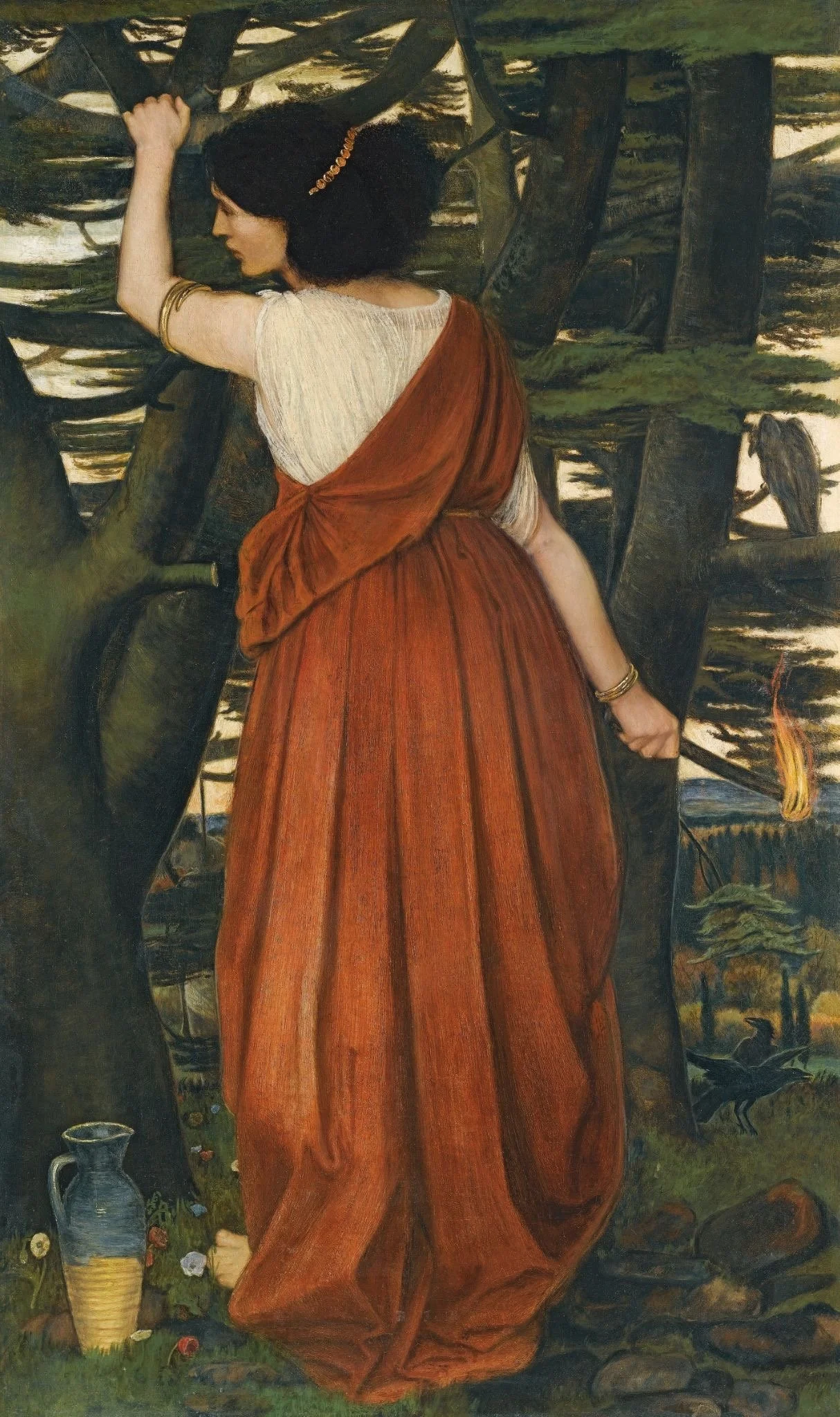
“Rispah, The Daughter Of Aiah” by John Roddam Spencer Stanhope, 1864. Photo from Wikimedia Commons.
Rizpah is one of the most tragic and one of the most heroic women in the Bible. Rizpah was a concubine of King Saul, and after Saul’s death, her two sons, Armoni and Mephibosheth, were executed by King David along with five others. Their corpses were left to decay in the open, but Rizpah, in a show of public grief and maternal protection, stood guard over the bodies of her children; “from the beginning of harvest until rain fell on them from the heavens; she did not allow the birds of the air to come on the bodies by day or the wild animals by night” (2 Samuel 21:10).
News of Rizpah’s actions must have spread throughout the kingdom, because David receives word of her months-long defense, and he finally allows her sons to have a proper burial. The grieving mother and former concubine, through “silent yet public protest,” wins out against Israel’s greatest king (“Rizpah” by Kloe Young and Lisa M. Wolfe).
Rizpah’s name means “hot coal” or “baking stone.”
After Saul’s death, his cousin Abner has sex with Rizpah. As an ally of David, Abner presumably does this in an attempt to take the throne from the House of Saul. Taking a former king’s wives or concubines was a way of laying claim to the throne. However, the Abner story illustrates how little agency Rizpah had over her own life.
Scholar Stephanie Buckhannon Crowder links Rizpah’s actions with the heart-wrenching work of modern-day mothers like Sybrina Fulton, mother of Trayvon Martin; Lucia McBath, mother of Jordan Davis; and Lesley McSpadden, mother of Michael Brown. From Mamie Till-Mobley to the Latin American mothers of the disappeared, maternal activism remains a powerful force. “...society can’t discount a mother’s love, no matter how peculiar, odd, or strange it may be. A mother’s pain has the potential to change the world” (When Momma Speaks, Stephanie Buckhanon Crowder, 62).
List of Reading & Resources:
Articles
Books