Rahab
Joshua 2; 6:16-25; Matthew 1:5
Joshua 2:1 Then Joshua son of Nun sent two men secretly from Shittim as spies, saying, “Go, view the land, especially Jericho.” So they went and entered the house of a prostitute whose name was Rahab and spent the night there.
Joshua 6:16-17 And at the seventh time, when the priests had blown the trumpets, Joshua said to the people, “Shout! For the Lord has given you the city. The city and all that is in it shall be devoted to the Lord for destruction. Only Rahab the prostitute and all who are with her in her house shall live because she hid the messengers we sent.
Matthew 1:5…and Salmon the father of Boaz by Rahab, and Boaz the father of Obed by Ruth, and Obed the father of Jesse.
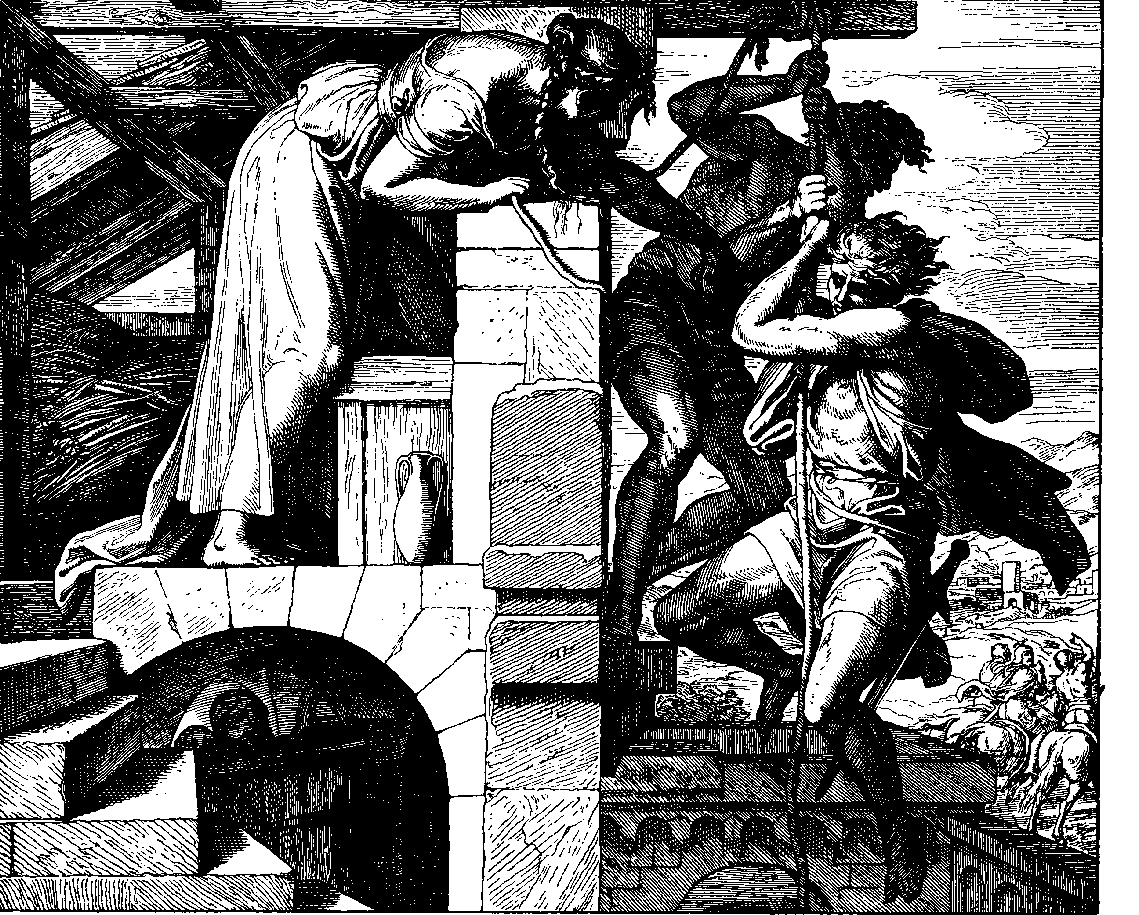
Escape from Rahab's House, as in Joshua 2, from a woodcut for "Die Bibel in Bildern", 1860, Julius Schnorr von Carolsfeld.
After the escape from Egypt and after their wilderness journey, the Israelites finally arrive at the Promised Land, only to discover a startling reality: the land is already occupied. Moreover, it’s not occupied by just anyone; when Moses sends spies into the land, they report back, “the people who dwell in the land are strong, and the cities are fortified and very large…We are not able to go up against this people, for they are stronger than we” (Numbers 13:31). The Israelites' complaints about the impossibility of facing such a people, even after all God has done for them, earns them forty years in the wilderness.
How ironic, then, that a member of that terrifying group proves vital to the Israelites' conquest of Canaan. Rahab, the Canaanite prostitute, harbors two Israelite spies during their reconnaissance mission in the city of Jericho. She not only shelters the two spies in her home: she lies to her own king about their whereabouts!
Why did Rahab do what she did? When the two Israelites come to her, she reveals she knows about their God. In the story of Israel’s conquest of the land, God flips the script. “Rahab, who begins as triply marginalized—Canaanite, woman, prostitute—moves to the center as bearer of a divine message and herald of Israel in its new land” (Tikva Frymer-Kensky).
When the walls of Jericho fall, and the city is taken by the Israelites, Rahab is spared. But not only Rahab, though, “all who belong to her” survive (Joshua 6:22). Her father, her mother, her sisters, and all of her kindred are saved. “Her family has lived in Israel ever since” (Joshua 6:25).
In the New Testament, Rahab appears in the Gospel of Matthew as an ancestor to both King David and Christ. She is also praised as an exemplar of faith in Hebrews 11:31.
There are notable parallels between Rahab’s story and earlier events in the exodus story. Like the Hebrew midwives of Exodus 1, she lies to a king to preserve the lives of the Israelites. A red marker protects her home, echoing the passover story of Exodus 12. And Rahab’s speech in Joshua 2 resembles the language of Exodus 15.
The Babylonian Talmud lists Rahab as one of the four most beautiful women in the world. The other three are Sarah, Abigail, and Esther (Megillah 15a).
List of Reading & Resources:
Articles
"The Women in Matthew’s Genealogy" by Caroline Parish and Kim Bauser McBrien
“Rahab: Bible” by Tikva Frymer-Kensky and Carol Meyers in Jewish Women’s Archive (2021)
"Remixed Gospel of Rahab: Who Are You Calling A Whore" by Rev. Wil Gafney, Ph.D.
"Rahab, the Broad, Symbolizes Israel’s Conquest of Canaan" by Prof. Leonard Greenspoon
Books
Podcasts