Jael
Judges 4:17-22 Now Sisera had fled away on foot to the tent of Jael wife of Heber the Kenite, for there was peace between King Jabin of Hazor and the clan of Heber the Kenite. Jael came out to meet Sisera and said to him, “Turn aside, my lord, turn aside to me; have no fear.” So he turned aside to her into the tent, and she covered him with a rug. Then he said to her, “Please give me a little water to drink, for I am thirsty.” So she opened a skin of milk and gave him a drink and covered him. He said to her, “Stand at the entrance of the tent, and if anybody comes and asks you, ‘Is anyone here?’ say, ‘No.’ ”But Jael wife of Heber took a tent peg and took a hammer in her hand and went softly to him and drove the peg into his temple, until it went down into the ground—he was lying fast asleep from weariness—and he died. Then, as Barak came in pursuit of Sisera, Jael went out to meet him and said to him, “Come, and I will show you the man whom you are seeking.” So he went into her tent, and there was Sisera lying dead, with the tent peg in his temple.
Judges 5:6 In the days of Shamgar son of Anath, in the days of Jael, caravans ceased, and travelers kept to the byways.
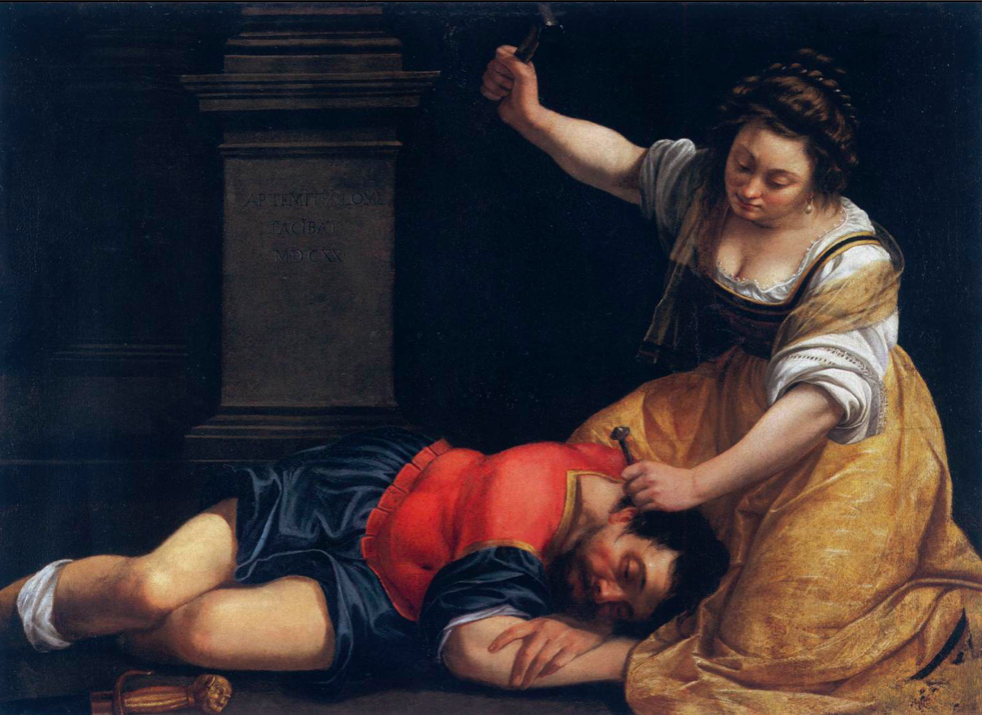
“Jael and Sisera” by Artemisia Gentileschi, 1620. Photo from Wikipedia.
Jael’s story appears in the Book of Judges. The Israelites had been at war with King Jabin of Canaan for twenty years when their judge Deborah received a message from God on how to defeat their enemy. Deborah delivers God’s message to Barak, the commander of Israel’s army, but he refuses to ride into battle without her. Deborah agrees to accompany Barak, but she warns him that doing so will mean Sisera, the Canaanite military commander, will be delivered into the hands of a woman.
The Israelites defeat the Canaanites, but Sisera flees the battle.
He takes refuge in Jael’s tent because her husband, Heber the Kenite, had made peace with King Jabin. While Sisera sleeps, Jael kills him with a tent peg, fulfilling Deborah’s prophecy that God would “sell Sisera into the hand of a woman” (Judges 4:9). Judges 5, the poetic account of events, praises Jael: “Most blessed of women be Jael, the wife of Heber the Kenite, of tent-dwelling women most blessed” (Judges 5:24).
The Bible is full of surprising heroines and heroes, from the trickster Jacob to the sex worker Rahab. Still, perhaps no figure is as unexpected as Jael. The story of the defeat of the Canaanites under the Israelite judge Deborah is filled with twists, turns, and subversions: The Israelite victory is delivered by a woman, but not Deborah; the Canaanite military leader Sisera is killed, but not by an Israelite; and the victory takes place not on the battlefield, but in the domestic sphere of Jael’s tent. The narrative sets up one set of expectations only to knock them down. Like Sisera, we don’t see Jael coming.
Rabbinic tradition lists Jael as one of the devout women converts. The others are Hagar, Asenath, Zipporah, Shiphrah, Puah, the daughter of Pharaoh, Rahab, and Ruth (“Yael Wife of Heber The Kenite: Midrash and Aggadah” by Tamar Kadari).
Jael’s name means “ibex,” a kind of mountain goat.
Sisera is first presented as a notorious military commander, and yet he behaves like a child in the story, abandoning his army and running away. Jael treats him accordingly, covering Sisera with a rug and giving him milk to drink. Once Jael puts her “child” to bed, she kills him.
In the New Testament, “Elizabeth reprises Deborah’s blessing of Jael” when she blesses the pregnant Mary in Luke 1:42 (Womanist Midrash by Wilda C. Gafney).
List of Reading & Resources:
Articles
“Sex and Violence in the Days of Jael” (4 parts) by Marg Mowczko
“Jael: Bible” by Tikva Frymer-Kensky, updated by Caryn Tamber-Rosenau
“Reading Jael’s Story in a Women’s Prison” by Sarah Jobe
Books