The Israelite Slave Girl
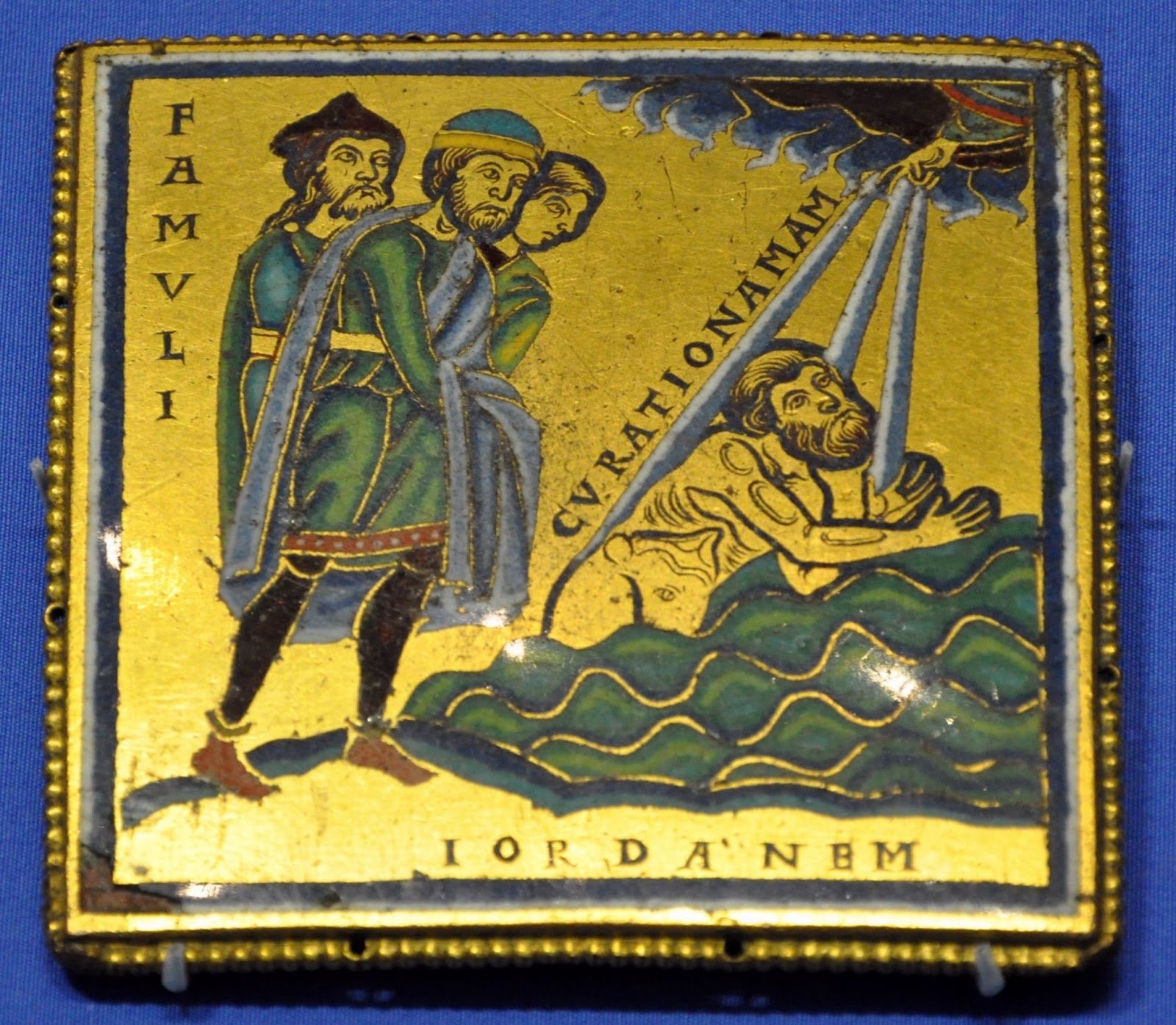
“Naaman is cured from leprosy,” from Art in the Christian Tradition, a project of the Vanderbilt Divinity Library.
The commander of the Aramean army, Naaman, suffered from leprosy. Fortunately for him, a slave girl in his household knew how he could be cured. The girl was an Israelite, taken captive from her home during a raid. She worked for Naaman’s wife, and the girl told the woman, “If only my master would see the prophet who is in Samaria! He would cure him of his leprosy” (2 Kings 5:3). The prophet in Samaria—the prophet in whom this little girl has so much faith—is Elisha. Naaman’s wife tells her husband about Elisha, and he goes to meet the holy man.
Elisha instructs Naaman to bathe in the Jordan seven times.
At first, Naaman is angry, but his servants advise him, “Father, if the prophet had commanded you to do something difficult, would you not have done it? How much more, when all he said to you was, ‘Wash, and be clean’?” (2 Kings 5:13). Naaman once again takes the advice of his workers, and it pays off. He is healed. As a result, he becomes a worshipper of the God of Israel.
This unnamed girl, enslaved and far from home, “had no worldly power—yet across the centuries, she has been a mighty evangelist, leading others, even her enemies, to God…Over a thousand years later, perhaps Jesus would think of this particular young soul when he said: ‘Let the little children come to me, and do not stop them; for it is to such as these that the kingdom of heaven belongs’” (Rev. Lindsay Hardin Freeman).
Samaria was the capital city of the northern kingdom of Israel.
“Reversal of expectations is a central theme in both testaments. Such a text invites us to discover wisdom from surprising sources, including children, and perhaps least expected of all, slave girls” (Eve Isn't Evil by Julie Faith Parker, pg. 144).
Jesus of Nazareth references the healing of Naaman in Luke 4:27.
The skin condition translated as “leprosy” in the Bible is not the disease called “leprosy” today (i.e., Hansen’s disease). Instead, it refers to skin discoloration. You can find out more about Biblical leprosy here: “Skin Disease and Social Exclusion” by Myrick C. Shinall