Huldah
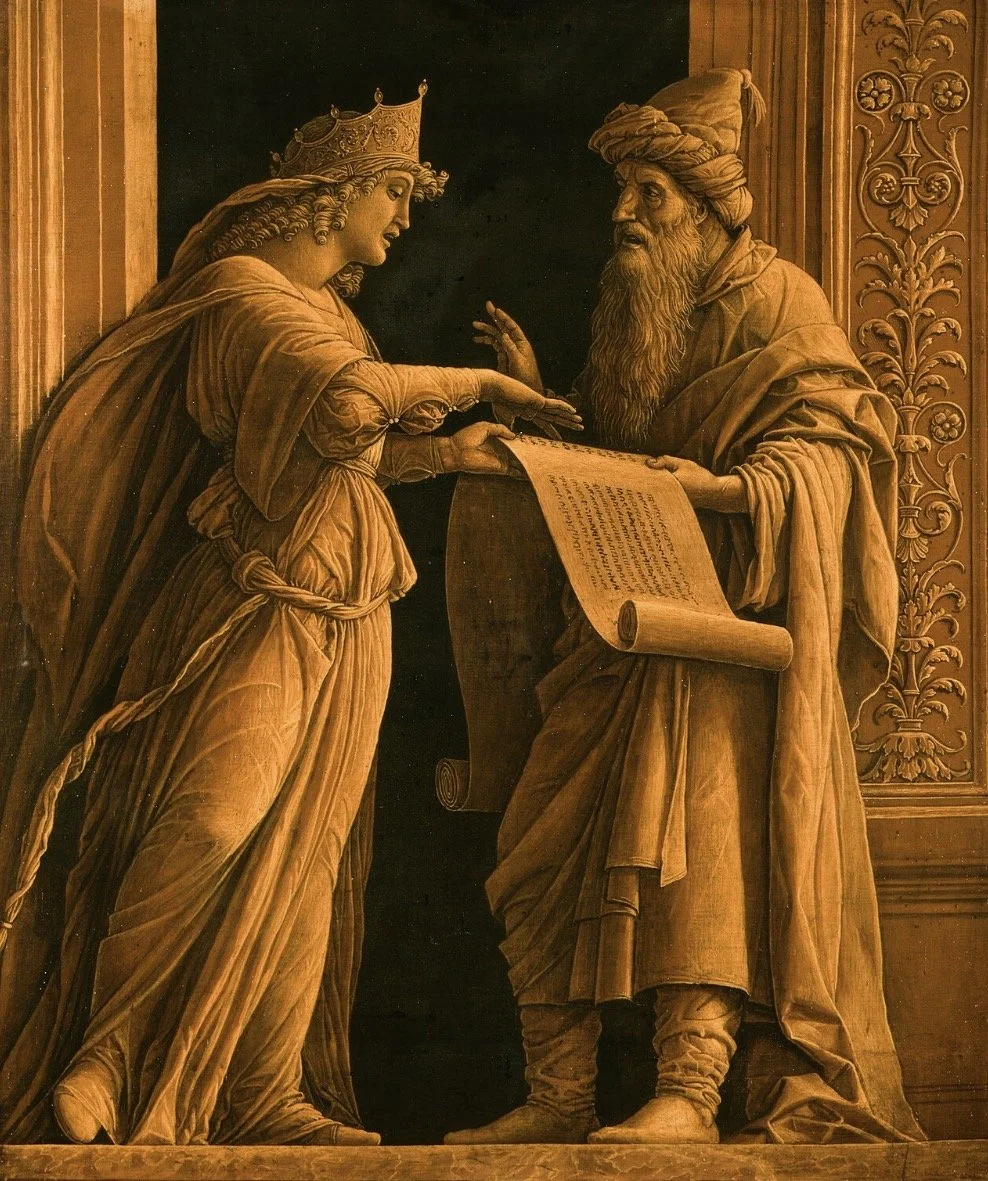
“Sibyl and Prophet” by Andrea Mantegna, circa 1495. Photo from Wikimedia Commons.
Did you know a woman prophet played a role in the canonization of the Bible?
When King Josiah discovers a lost scroll (called “the book of the law”) during temple repairs, he faces a conundrum (2 Kgs 22:8). Is the book a true representation of God’s wishes? Josiah realizes that his kingdom has unwittingly failed to abide by the rules and regulations in the forgotten scroll. Should he enact the laws described in the newly discovered book?
Seeking guidance, he brings the scroll to the prophet Huldah, who verifies that the document is genuine. King Josiah reforms his kingdom in keeping with the scroll’s mandates, cementing his status as the last good king of Judah.
Huldah’s story is presented in both Kings and Chronicles (2 Kgs 22; 2 Chr 34). Neither narrative finds Huldah’s gender notable; prophecy was a position of religious authority available to women and men alike. Biblical women prophets are evident as early as Miriam in Exodus and as late as Anna in Luke.
Given the reforms instituted by King Josiah and the list of curses referenced by Huldah, some scholars suggest the scroll discovered was the Book of Deuteronomy.
Huldah authorizes a written document as having genuine religious authority. “Her validation of a text thus stands as the first recognizable act in the long process of canon formation” (Claudia V. Camp). Huldah is, arguably, “the founder of Biblical studies” (“Huldah, the Prophet: Reading a (Deuteronomistic) Woman’s Identity” by Renita J. Weems).
List of Reading & Resources:
Articles