Hannah
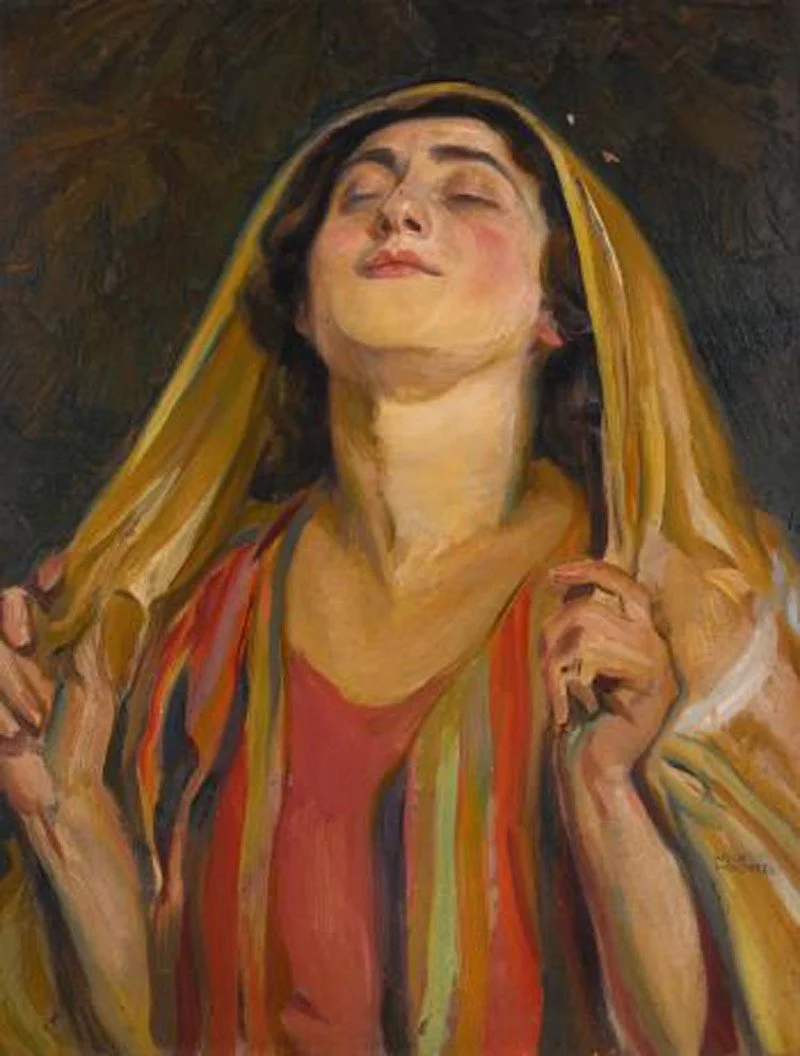
“Hannah at Prayer” by Wilhelm Wachtel, from Art in the Christian Tradition, a project of the Vanderbilt Divinity Library.
Hannah was the mother of Samuel, Israel’s great prophet, priest, and judge. Like the matriarchs before her, Hannah struggled with fertility. Despite her barrenness, Hannah is beloved by her husband, Elkanah. However, her difficulty with conception is exacerbated by her co-wife Penninah, who mocks Hannah for her lack of a child.
While worshipping at Shiloh, Hannah prays silently but emphatically for God to intervene. She makes a vow to God, saying, “O Lord of hosts, if only you will look on the misery of your servant and remember me and not forget your servant but will give to your servant a male child, then I will set him before you as a nazirite until the day of his death. He shall drink neither wine nor intoxicants, and no razor shall touch his head” (1 Samuel 1:11).
The priest at Shiloh, Eli, sees Hannah praying and mistakes her prayer for drunken babbling. He confronts her, and Hannah has to defend herself. She tells Eli, “No, my lord, I am a woman deeply troubled;
I have drunk neither wine nor strong drink, but I have been pouring out my soul before the Lord. Do not regard your servant as a worthless woman, for I have been speaking out of my great anxiety and vexation all this time” (1 Samuel 1:15).
Eli is moved by Hannah’s words and tells her God will answer her prayer. He is right; Hannah gives birth to a boy she names Samuel. When the child is old enough, she brings Samuel to Shiloh to serve God alongside Eli. And despite her initial trouble conceiving, Hannah has three sons and two daughters after Samuel's birth.
Though Hannah is best known as the mother of Samuel, she has a lasting literary legacy in Scripture. Her prayer of thanksgiving in 1 Samuel 2 is echoed by Mary in the famous Lukan passage known as the Magnificat: “My soul magnifies the Lord, and my spirit rejoices in God my Savior” (Luke 1:46-47).
Hannah’s name comes from the Hebrew word for “grace.”
Hannah’s silent prayer to God can be viewed as an innovation in religious practice. At the time, prayers were said aloud, which may explain Eli’s confusion.
Anna is the Hellenized form of Hannah; the prophet Anna in Luke 2:36 is possibly named after the Hannah of 1 Samuel.
List of Reading & Resources:
Articles:
“Hannah: Bible” by Lillian Klein from Jewish Women’s Archive
“This Rosh Hashanah, we need to listen to Hannah’s feminist story” by Rishe Groner
“A Wife's Vow – The Husband's Woe? The Case of Hannah and Elkanah (I Samuel 1,21.23)” by Ruth Fidler
“This Rosh Hashanah, We Need to Listen to Hannah’s Feminist Story” by Rishe Groner
Books: