Daughter of Pharaoh
Exodus 2:5-10 The daughter of Pharaoh came down to bathe at the river, while her attendants walked beside the river. She saw the basket among the reeds and sent her maid to bring it. When she opened it, she saw the child. He was crying, and she took pity on him. “This must be one of the Hebrews’ children,” she said. Then his sister said to Pharaoh’s daughter, “Shall I go and get you a nurse from the Hebrew women to nurse the child for you?” Pharaoh’s daughter said to her, “Yes.” So the girl went and called the child’s mother. Pharaoh’s daughter said to her, “Take this child and nurse it for me, and I will give you your wages.” So the woman took the child and nursed it. When the child grew up, she brought him to Pharaoh’s daughter, and he became her son. She named him Moses, “because,” she said, “I drew him out of the water.”
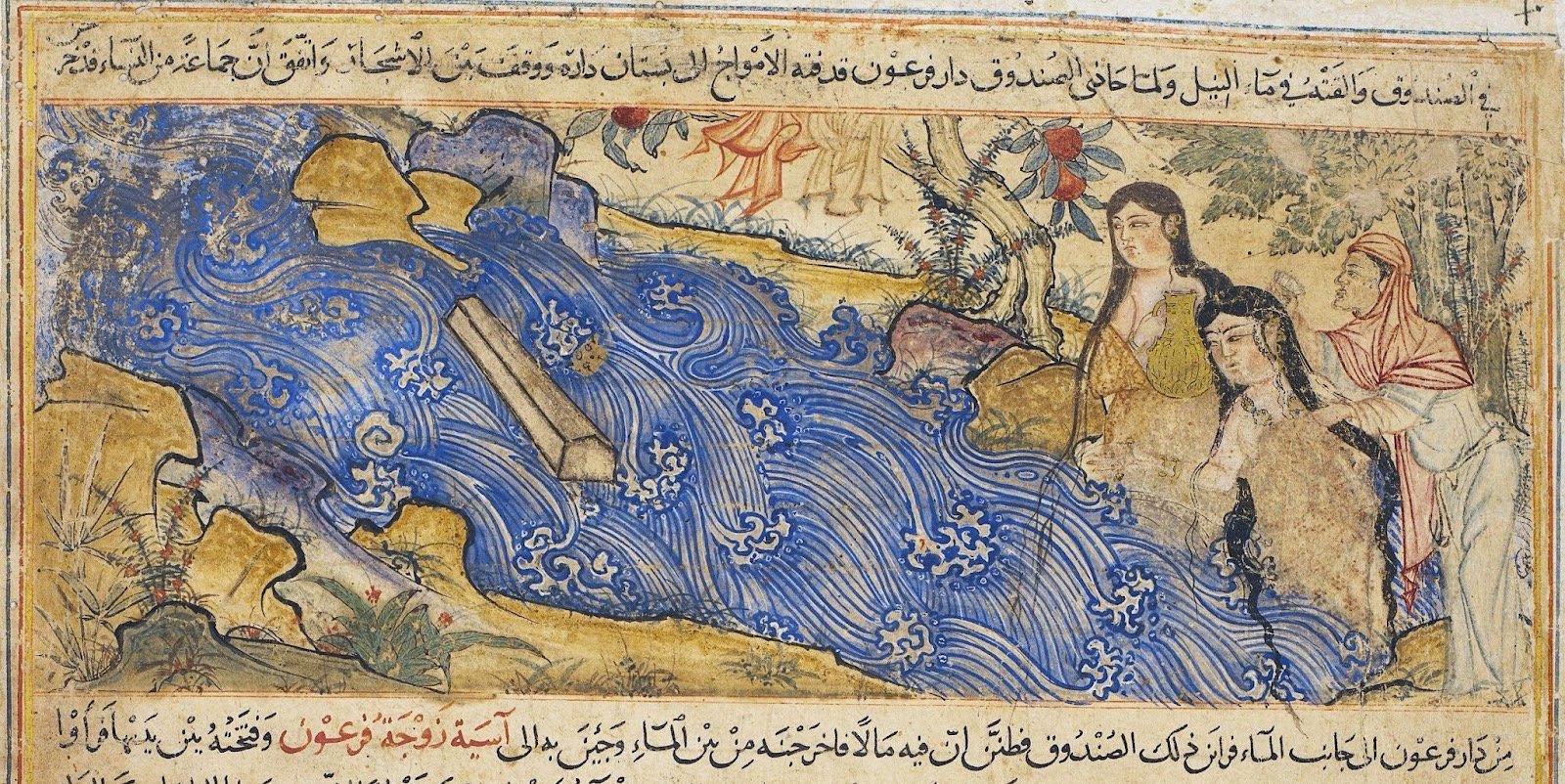
Asiya finds baby Moses. Illustration from the manuscript Jami' al-tawarikh, c. 1310, Edinburgh University Library.
When the daughter of Pharaoh finds a baby boy in the river, she knows immediately that he must be Hebrew. Her own father had decreed that all Hebrew baby boys should be killed. She defies his order, though, by finding a nurse for the child and taking him as her son. The nurse she finds is the child’s birthmother, and the child, Moses, becomes the deliverer of the Hebrew people.
Ironically, given his command, the Pharaoh’s plans are foiled by women. The actions taken by Moses’ birthmother, his sister, and his adoptive mother keep him alive. While the king of the Egyptians is the villain of the Exodus story, it’s notable that the great hero of the Exodus story is both rescued and raised by an Egyptian woman.
Despite their importance in the Exodus story, neither the daughter of Pharaoh nor the Pharaoh himself is named.
The daughter of Pharaoh is sometimes conflated with Bithia, an Egyptian princess named in 1 Chronicles 4:17.
“Numerous women are associated with water in Exodus: Pharaoh’s daughter, who bathes in the river from which she draws out Moses (2:5); Miriam, who first appears at the banks of the river (2:7) and is last mentioned in Exodus at the shore of the sea (15: 21); and Zipporah, who like Rebekah and Rachel (Gen 24. 15-20; 29:9-10), is associated with the water of a well (Ex. 2:15-17)” (“Exodus” by Drorah O’Donnell Setel in Women’s Bible Commentary, 1998).
In Islamic tradition, the woman who adopts Moses is Pharaoh’s wife (Asiyah) not his daughter (Quran 28:9).
List of Reading & Resources:
Articles
Books