Daughter of Jephthah
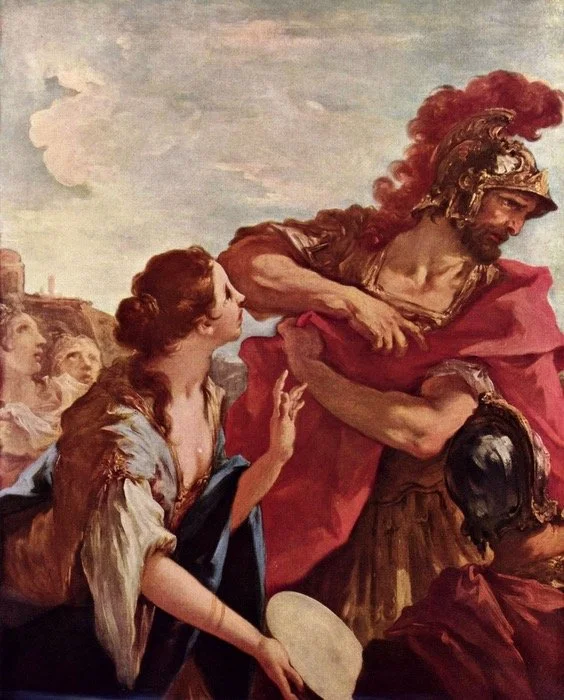
“Jephtha's Return,” by Giovanni Antonio Pellegrini, 1700-1725. From Art in the Christian Tradition, a project of the Vanderbilt Divinity Library.
The daughter of Jephthah appears in one of the Bible’s most horrifying stories. In exchange for victory in battle, the biblical judge Jephthah makes a vow to God that he will sacrifice whatever comes out of the door of his house first. He returns home, and his daughter comes out to meet him.
When he sees her, Jephthah tells her, “Alas, my daughter! You have brought me very low; you have become the cause of great trouble to me” (Judges 11:35). It’s worth noticing Jephthah’s response. He places the blame on his daughter: “You have brought me very low.” Jephthah takes no responsibility for his own foolish vow.
His daughter responds decisively. If her father made a vow to God, he must keep it. She asks only that she can spend two months in mourning with her friends. When the two months ended, “she returned to her father, who did with her according to the vow he had made” (Judges 11:39).
After her death, “there arose an Israelite custom that for four days every year the daughters of Israel would go out to lament the daughter of Jephthah the Gileadite” (Judges 11:39-40).
God intervened before Abraham sacrificed Isaac, and elsewhere in the Bible, child sacrifice is forbidden. So why wasn’t Jephthah's daughter saved? That this story takes place during the time of the judges may provide a clue: “Some suggest that it is meant to point to the rash and foolish behavior of Jephthah. But his unconscionable behavior would also have been a sign of Israel’s depravity and thus an argument for instituting monarchical rule” (“Daughter of Jephthah: Bible” by Karla Bohmbach).
When the daughter of Jephthah welcomes her father home with drumming and dancing, she’s participating in a larger tradition. In Ancient Near Eastern cultures, the drum was a woman’s instrument. Women drummers performed together in both secular and religious contexts. Want to learn more about women drummers? Check out our blog post here: “Female Drummers in the Ancient Near East” by McKenzie Brummond.
The women who mourn with Jephthah’s daughter are remarkable in their own right. Women’s friendships are rarely of interest to the biblical authors. “‘Women friends,’ the feminine noun, occurs only here in Judges 11:37 and 38 and in Psalm 45 for the companions of the daughter of Tyre marrying an Israelite monarch…Not only is the vocabulary rare, but the actions are incomparable: Job’s male friends sat with him in his grief for seven days and seven nights and then rose to explain to him repeatedly that his suffering was his own fault. These women, more likely girls, put their lives on hold for two months” (Womanist Midrash, Volume 2, by Wilda C. Gafney). And after Jephtha’s daughter is sacrificed, it’s the women of Israel who preserve her memory through ritual: “They could not protect her life, but they could protect her dignity by retelling her story” (“The Dark Stories” by Rachel Held Evans).